Two Worlds, One Advertising Market: Record Platform Growth Meets a UK Consumer Squeeze
6/11/2026 6:24 PM
By Tony Emment
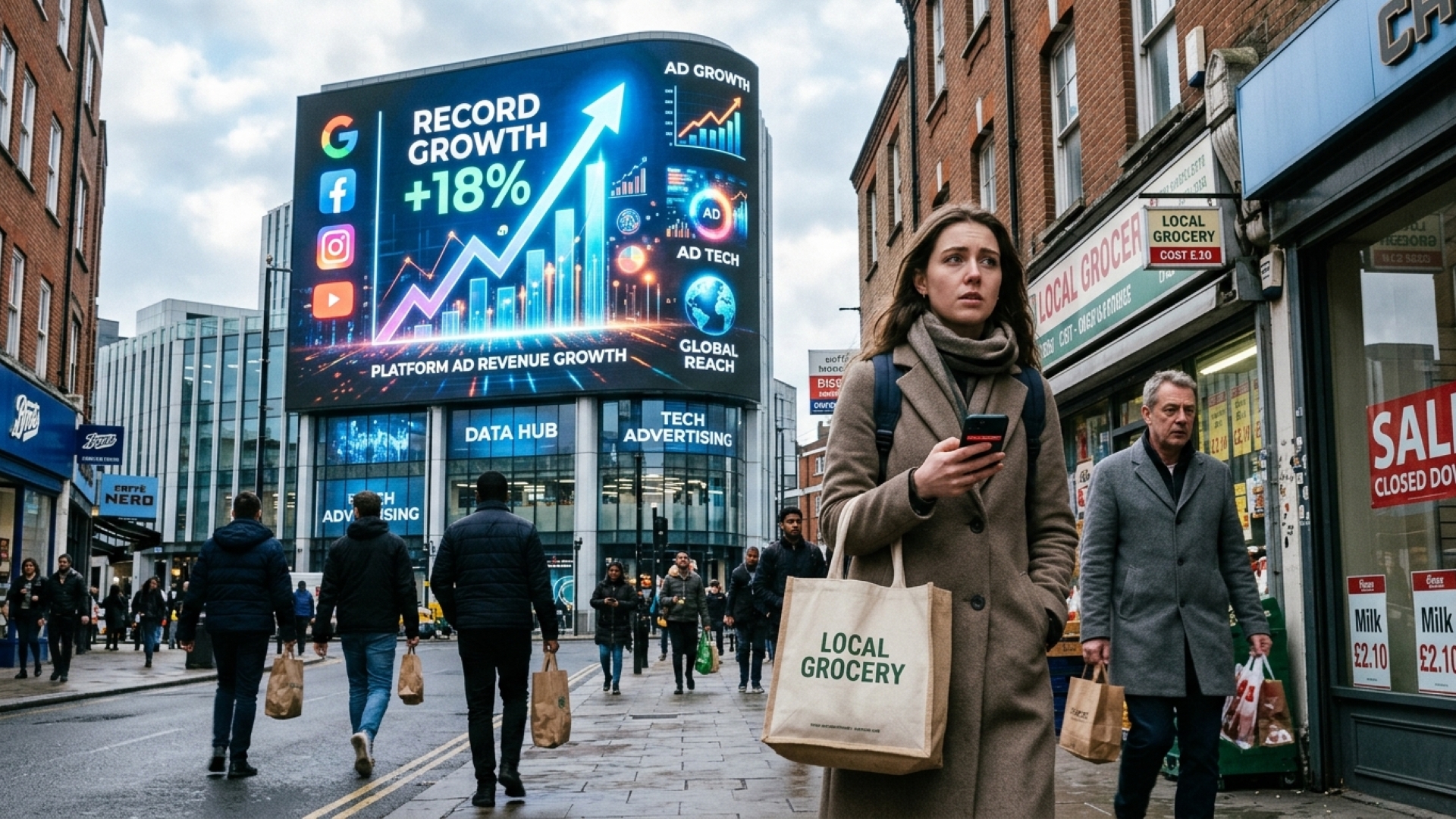
A stark divide has opened across the media market: while global tech platforms report double-digit ad growth, UK consumers face acute financial strain. Brands risk mistaking platform revenue expansion for advertising effectiveness. Navigating this requires scrutinising rising auction costs and demanding independent proof of genuine, incremental return.
The Growing Industry Contradiction
There is a striking contradiction unfolding across the modern advertising economy.
The world’s largest digital media platforms continue to post formidable financial results, delivering double-digit revenue surges in their third-quarter earnings. Yet across high streets and kitchen tables in the UK, consumers remain under severe economic strain: household balance sheets are stretched, discretionary spending is fiercely guarded, and sentiment remains cautious.
It feels increasingly as though two parallel worlds are operating within the same economy.
On one side, the major walled gardens and digital ecosystems—Amazon, Meta, Alphabet, Reddit, Pinterest, and Microsoft—are expanding their commercial reach and ad revenues. On the other, the very consumers these platforms target are thinking twice before tapping "buy".
For marketing and procurement leaders, this disconnect poses a crucial question: when the digital media market accelerates at such pace, how can brands invest strategically without merely following platform momentum into diminishing returns?
Global Platforms Continue To Go From Strength to Strength
The latest Q3 financial disclosures underline the sheer commercial velocity behind the world’s major media networks:
- Meta: Total revenue climbed 26% year-on-year to $64.6bn, with its core advertising engine generating approximately $63.1bn. Ad impressions rose 10%, while the average price per advertisement increased by 14%.
- Alphabet (Google): Total revenue expanded 25% to $127.6bn. Total advertising revenue reached approximately $82bn, led by Google Search and other ad properties growing 12% to $63.4bn.
- Amazon: Advertising services revenue reached $19.6bn, marking an 11% year-on-year increase (or 12% in constant currency).
- Reddit: Advertising revenue soared 54% year-on-year to $847m, illustrating the rapid commercialisation of community conversation.
- Pinterest: Revenue increased 12% to $1.17bn, accompanied by a 10% rise in global monthly active users to an all-time high of 661 million.
- LinkedIn / Microsoft: While Microsoft does not break out standalone quarterly LinkedIn ad figures, its Search and News Advertising revenue (which reflects broader advertising products and LinkedIn Marketing Solutions) rose by 10% ex-TAC.
These numbers are not merely a byproduct of higher user counts. They reflect an escalating ability to monetise audience attention through machine-learning algorithms, AI-driven dynamic creative tools, automated bidding, and aggressive competition among advertisers.
Meta’s performance is a case in point. Growing ad impressions by 10% while lifting average pricing by 14% proves that revenue expansion is being driven simultaneously by increased ad load/engagement and escalating auction pricing. Meanwhile, the steep revenue curves at Reddit (+54%) and Pinterest (+12%) highlight how ad budgets are diversifying into high-intent, community-driven, and visual-discovery ecosystems.
The takeaway is unmistakable: platform inventory is expanding, but accessing it is becoming more expensive.
The UK Advertising Market Is Expanding in Parallel
This tech-giant momentum is directly mirrored in domestic market figures.
According to the latest Expenditure Report from the Advertising Association and WARC, UK advertising expenditure rose by 11.0% in Q2 to reach £12.3bn. Full-year UK investment is now projected to hit £51.3bn, representing 9.9% year-on-year growth.
However, headline market growth obscures dramatic shifts beneath the surface. Channel forecasts for the full year reveal where the capital is concentrating:
- Retail media: +23.0%
- Social media: +20.7%
- Addressable TV: +14.7%
- Digital out-of-home (DOOH): +12.9%
- Search: +9.1%
- Total TV: +0.9%
Growth is heavily skewed towards channels offering closed-loop attribution, first-party customer data, algorithmic targeting, and granular performance tracking. Budgets are gravitating towards digital environments that promise immediate measurability.
But What Is Actually Happening to the Consumer?
Here lies the strategic paradox. While platform revenues and ad expenditure climb at near-record rates, UK consumer reality tells an entirely different story.
Consumer sentiment remains fragile. Persistent core living costs, elevated borrowing rates referenced in the latest Bank of England Monetary Policy Report, and ongoing caution tracked by the Which? Consumer Insight Tracker show that UK households are actively rationalising their outgoings. Discretionary margins are thin. Shoppers are trading down, delaying replacement cycles, cherry-picking promotional periods, and switching to private-label alternatives.
The AA/WARC commentary explicitly notes this tension: UK ad investment continues to climb even as broader macroeconomic consumer confidence remains subdued.
This divergence introduces critical commercial implications:
- Engagement does not equal purchasing power: Consumers may be spending more time scrolling social feeds, reading discussion threads, or browsing retail apps, but that does not mean they have more money to spend.
- Platform revenue is not brand revenue: A platform reporting 25% revenue growth simply means advertisers are bidding harder against each other; it is not proof that the advertisers themselves are seeing an equivalent increase in profitable, incremental volume.
- Category vulnerability varies: While discount grocers, value retailers, and utility-driven propositions may benefit from consumers trading down, premium and mid-market categories face compressed margins and hesitant shoppers.
The Danger of Confusing Platform Growth With Advertising Effectiveness
At 23 Media Audits, we regularly see the risks that arise when brands confuse macro platform performance with commercial media efficiency.
There is an understandable impulse to chase channel growth. When tech giants post stellar quarters and boast cutting-edge AI features, marketing teams face board-level pressure to allocate more spend to those platforms. Yet without rigorous auditing and independent measurement, brands risk pouring money into an inflating auction.
Here are five critical considerations every advertiser should weigh:
- More investment does not equate to better value: When ad prices increase—such as Meta’s 14% lift in average price per ad—brands must establish whether they are securing higher-quality media or simply paying a premium to reach the same audience. Higher auction clearance prices demand deeper scrutiny into CPMs, frequency capping, viewability, and incremental reach.
- Beware of walled-garden dependency: Concentrating the lion’s share of media budgets within Meta and Google creates substantial commercial exposure. When performance softens or auction inflation accelerates, over-reliant brands have little leverage. Platforms such as Reddit, Pinterest, LinkedIn, premium online video, and programmatic CTV provide valuable opportunities to diversify reach—provided they align with verified audience behaviour rather than fashion.
- Balance short-term conversion with demand creation: In a subdued consumer climate, the pressure to focus exclusively on lower-funnel, short-term performance media is acute. However, over-indexing on direct conversion often leads to brands paying repeatedly to convert existing brand equity without replenishing the top of the funnel. When consumer budgets are tight, sustaining mental availability and brand consideration is what protects pricing power.
- Attributed sales are not always incremental sales: Digital platform dashboards are calibrated to claim credit for conversions. However, automated targeting often directs spend towards consumers who were already planning to purchase. Establishing incrementality—understanding what sales would have occurred regardless of the campaign—requires econometrics (MMM), geo-lift testing, and independent cross-channel analysis rather than self-reported attribution models.
- Audit digital quality and contract transparency: As programmatic and digital spends rise, so do hidden inefficiencies: invalid traffic (IVT), non-viewable impressions, MFA (made-for-advertising) websites, audience overlap, and agency trading margins. Ensuring that every pound delivered is verified against rigorous quality parameters is the most reliable way to recover working media value.
Five Strategic Priorities for Brand Leaders
To bridge the gap between platform inflation and consumer constraint, marketing, procurement, and finance teams should align around five core practices:
- Lead with the consumer, not the ad product: Calibrate media weight to real consumer purchasing behaviour, category trade-offs, and price elasticity—not to a platform’s latest ad release.
- Re-evaluate channel distribution: Question historical media splits. Model where diminishing returns have set in across saturated digital channels and where incremental reach can be unlocked more cost-effectively.
- Deconstruct platform price inflation: Scrutinise whether digital CPM and CPC inflation is delivering equivalent business outcomes. Demand transparency on fees, auction mechanics, and inventory placement.
- Protect long-term brand equity: Resist cannibalising upper-funnel brand investment to fund rising performance ad costs. In a selective consumer environment, brand salience drives bottom-line choice.
- Embed independent auditing into governance: Platform dashboards grade their own homework, and media agencies often operate under conflicting commercial incentives. Independent auditing ensures your investments are benchmarked, validated, and genuinely accountable to business performance.
The 23 Media Audits Perspective
The UK advertising market is demonstrating remarkable resilience, and the rapid pace of digital and retail media innovation offers brands unprecedented reach and capabilities. But marketing leadership cannot afford to view platform growth in a vacuum.
There is a widening chasm between a booming advertising supply market and an economically constrained consumer base.
The ultimate commercial winners will not be the advertisers that allocate the largest budgets to the fastest-growing digital auctions. They will be the brands that execute with commercial discipline: scrutinising underlying costs, interrogating incrementality, protecting brand health, and verifying the genuine return on every pound spent.
The question for brand leaders is simple: as the digital advertising market continues to expand, are you truly capturing value—or simply funding the inflation?
Digital Media Plan Guide
Find out the key steps involved in Planning media
Looking to improve your digital media plan? Access our 10 step guide to see metrics advertisers should demand as part of their digital media plan.
